Chang Weisi
The Dark ForestChang Weisi is a general in the People’s Liberation Army and the commander of the Chinese Space Force. His decisive significance lies in the tension he carries between command and uncertainty. He helps build institutions for a war whose enemy can see almost everything humanity communicates, yet he never possesses the reassurance of certain victory. His authority is therefore not the authority of a triumphant conqueror but of a custodian who keeps a fragile civilization organized while history moves beyond any individual’s control.
Identity and Military Position
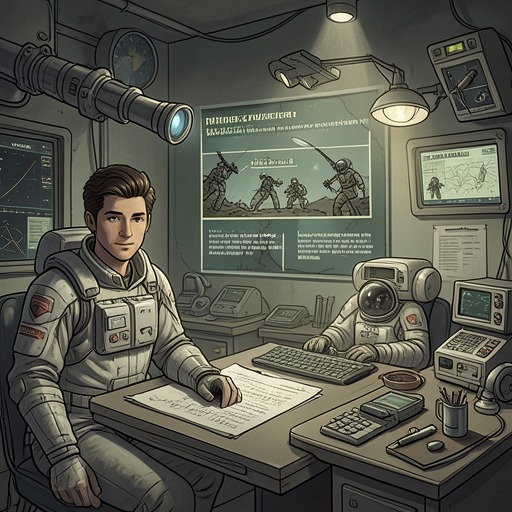
Chang Weisi occupies several connected roles: he is a senior PLA officer, the commander of the Chinese Space Force, and later the commander of its Political Department. The military hierarchy around him includes Wu Yue, a PLA Navy captain, Zhang Beihai, a political commissar and Space Force officer, and George Fitzroy, a United States general who coordinates at the Planetary Defense Council and serves as a military liaison to the Hubble II project. Chang’s position places him at the intersection of national command, international defense coordination, and the emerging military culture of space.
His command is defined by the unusual historical conditions of the Trisolar Crisis. The arrival of additional Sophons makes Earth effectively transparent to the enemy: meetings, files, computer systems, plans, deployments, and communications can all be observed. Yet the Trisolarans’ reliance on direct, open thought leaves them deficient in camouflage, deception, and strategic trickery. Chang’s institutional world must therefore protect and exploit a uniquely human resource: the private inner mind. The Wallfacer Project emerges from this contradiction, using plans conceived and directed without external communication to preserve secrecy where ordinary military organization cannot.
Leadership During the Crisis
At a Space Force Political Department meeting, Chang remains silent for an unusually long time after opening the proceedings. He studies the political officers seated around the table, taps his pencil, and appears absorbed in the distance before drawing himself back into the room. The hesitation is not presented as indecision alone; it marks his recognition that he has entered the very group he once viewed from outside. After an order from the Central Military Commission appoints him commander of the Political Department of the Armed Forces, he tells the officers that he has accepted the appointment but only now understands that they are the most beleaguered people in the Space Force and that he has become one of them.
Chang then proposes an off-the-record exchange in which the officers should speak with complete candor. His appeal to behave like Trisolarans for once is pointed: the enemy’s directness is a weakness in deception, but it also supplies an image of radical openness. Chang wants that openness among his own officers because future work depends on recognizing the strain borne by the political apparatus. His leadership does not erase institutional pressure; it makes that pressure speakable, at least within a protected room.
His strategic temperament also appears in his conversations with Zhang Beihai. Chang supports practical experience in space and argues that a space strategist must possess a genuine consciousness of space. Earlier, sending one person upward had cost tens of millions, whereas the space plane makes such experience cheaper and more attainable. He criticizes the Space Force for being too much like a college of empty talk and supports placing more strategists in space. The remark reveals a commander trying to transform space from an abstraction discussed by officials into an environment physically known by those who must command within it.
Yet Chang is also constrained by higher authority. He tells Zhang that the Central Military Commission has judged the proposal to send political cadres into the future as reinforcements premature. The plan has not been rejected; research and planning will continue, but execution must wait until the Space Force has more qualified political cadres and can reduce its present workload. Chang therefore recognizes Zhang’s long-term perspective while refusing to confuse strategic importance with immediate feasibility. His method is incremental, institutional, and patient, even when the historical stakes demand imagination on a civilizational scale.
Relations with Zhang Beihai and the Military Institution
Chang’s relationship with Zhang Beihai is marked by respect, restraint, and an awareness that Zhang thinks across a longer temporal horizon than ordinary administration permits. When Zhang suggests that plans should keep the entire four-century period in view and distinguish what is urgent from what is important, he deliberately withholds the argument from formal settings. Chang understands both the value and the political danger of such thinking. He reports that higher authorities have affirmed Zhang’s long-term outlook, but he also emphasizes that the future-reinforcement project remains premature.
The emotional depth of this relationship becomes clearer after Zhang visits his dying father and announces that he has joined the Space Force. The father responds with silence, the same silence through which he had educated Zhang throughout his childhood. Later, at the end of Chang’s life, the general repeatedly mentions Zhang Beihai’s name while lucid on his deathbed. The recurrence gives their professional connection the weight of a final recognition. Zhang is not merely one officer among many in Chang’s career; he represents a form of strategic consciousness that Chang identified, encouraged, and continued to remember when his own life was ending.
Chang’s dealings with other institutions are equally revealing. The Wallfacer Project is created because mainstream defense planning has become fully exposed to the Trisolarans, while a parallel strategy must remain hidden in human thought. The project grants its chosen figures immense popular and political capital: the public turns them into messianic figures, science-fiction films portray them as superheroes, and their apparent supernatural authority makes vast resources available. Luo Ji is the exception, remaining secluded and unseen. Chang’s military world must consequently operate alongside figures whose real intentions cannot be inspected even by allies, a radical form of command in which trust and concealment are inseparable.
Historical Arc and Ending
Chang’s career unfolds against a transformation that eventually makes the old national order unrecognizable. Later observers tell Luo Ji that there are no longer any great powers because every country has declined in political strength; the institution that has risen above them is a suprastate space fleet. This development retrospectively enlarges Chang’s importance. He begins as the commander of a national space force, but the military structures he helps establish belong to a historical process that ultimately weakens the sovereignty of individual countries and elevates space-based organization into the dominant political force.
The crisis also produces consequences that exceed military planning. After the combined fleet is annihilated, Escapism resurges after two centuries of silence. A European Commonwealth plan to choose one hundred thousand people for departure by nationwide drawing is approved by popular vote, but anger among those excluded leads to widespread riots. After the Battle of Darkness, escape from Earth is reinterpreted as a severing of the spiritual bonds that sustain human civilization, and the feared result is named Negacivilization. As the water droplet approaches Earth, crowds gather around spaceports and space-elevator bases to prevent any further departure, armed with laser pistols that could become destructive when fired in enormous numbers at a single point. The space future Chang helped organize is thus shadowed by a crisis over whether survival away from Earth would remain human survival at all.
The same year as the Mercury test, Chang retires. In his final media appearance, he openly acknowledges that he has no confidence in victory. The admission does not diminish the historical esteem attached to his work as the first commander of the Space Force; instead, it clarifies its moral character. He did not command because success was guaranteed. He commanded while knowing that the outcome might be defeat, and the prolonged anxiety of that responsibility damaged his health.
Chang dies at the age of sixty-eight. He remains lucid on his deathbed and mentions Zhang Beihai many times. His ending is therefore neither a military triumph nor a private reconciliation narrated at length, but a compressed meeting of history and memory. The commander who spent decades preparing humanity for an uncertain future dies with the name of a younger strategist still present in his thoughts. Chang’s life becomes a measure of institutional endurance: the Space Force changes the political shape of Earth, yet its first commander’s defining truth remains his inability to promise victory.
Narrative Role and Significance
Chang Weisi functions as a representative of the practical intelligence required by a civilization facing an enemy that can penetrate ordinary communication. He does not solve the problem of transparency through personal brilliance; he helps create institutions capable of preserving secrecy, coordinating political labor, training space strategists, and making decisions under conditions of radical uncertainty. In that sense, his individual career reflects a wider historical totality: military organization, political authority, scientific development, and psychological endurance are forced into one system by the Trisolaran threat.
His character also exposes the limits of information and openness. The Sophons can read language and stored data but cannot read uncommunicated human thoughts, so the Wallfacer Project turns inwardness into a strategic weapon. At the same time, the crisis repeatedly shows that transparency does not produce mutual understanding. Mike Evans stands on the bow of Judgment Day while communicating with a distant world through text displayed by a Sophon, yet the conversation reveals difficulties in understanding humanity’s reference materials. Later, the question of whether one benevolent civilization can determine another’s benevolence at the beginning of communication shows why suspicion persists even without proof of malicious intent. Chang’s leadership belongs to this world of incomplete knowledge: he must act without certainty, preserve institutions without promising safety, and accept that responsible command may be judged most clearly after the commander is gone.